The GTA Market
Middle Eastern food trade in Mississauga: the one GTA suburb with a market of its own
Mississauga is the one municipality outside the City of Toronto that supports a Middle Eastern food market large and distinct enough to plan for on its own. The 2021 Census recorded Arabic as the city's second most common non-official mother tongue after Urdu, with 33,265 people reporting it, 49,495 able to converse in it, and 120,965 Muslims — about 16.9% of the city's population, well above the Toronto CMA average (Statistics Canada, 2021 Census Profile, Mississauga).
This guide sets out what those numbers mean for a restaurant, grocer or café sourcing in Mississauga specifically, separate from the rest of the region — which is covered as a whole in where we deliver across the GTA.
Why Mississauga gets its own market read
Most GTA suburbs are best understood together — similar demographics, similar buying patterns, covered in one regional guide rather than a page each. Mississauga is the exception: its own city government (separate from Toronto, sitting in Peel Region), a large enough Arabic-speaking and Muslim population to register clearly in city-level census data rather than getting folded into a regional average, and a retail and foodservice geography — plazas along Dundas, Dixie and Central Parkway, a dense concentration of halal restaurants and grocers — that operates on its own terms.
That combination is why this page exists on its own, separate from the Levantine food economy of Toronto and from Scarborough's Levantine food corridor, which sit inside the City of Toronto's own census geography.
Language and community, by the numbers
Arabic is Mississauga's second most common non-official mother tongue, behind only Urdu — 33,265 residents reported it as a mother tongue in the 2021 Census, and 49,495 reported being able to converse in it, a wider figure that includes people who learned it as a second or additional language. Both numbers point to a community large enough to sustain dedicated grocers, bakeries and restaurants rather than a single shared aisle (Statistics Canada, 2021 Census Profile, Mississauga).
Mississauga's Arab visible-minority population was counted at 42,805 in the same census — a meaningful share of a city of roughly 717,000 people, and one that shows up directly on the ground in the density of Middle Eastern grocers and restaurants along the city's main commercial corridors.
What the census can't show — but any buyer driving the city can — is how directly those numbers translate into trade: halal butchers and Levantine bakeries anchoring plazas, grocers with full Levantine aisles rather than a single international shelf, and cafés where cardamom coffee is the default rather than the specialty. The figures above are the demand floor under all of it.
Muslim population and halal demand
The clearest number in the whole picture is 120,965 — Mississauga's Muslim population in the 2021 Census, about 16.9% of the city, compared with roughly 10.1% across the Toronto CMA as a whole (Statistics Canada, 2021 Census Profile, Mississauga). That gap is the clearest single reason halal-focused grocery and foodservice does disproportionately well in Mississauga relative to the region.
None of that translates into a specific certification claim on any one product — halal status has to be verified per product, per supplier, which halal grocery wholesale in the GTA covers in full, alongside how Canadian certification actually works.
One further data point, worth quoting with its date attached rather than as current fact: Nourish Food Marketing's research, as reported by NOW Toronto in October 2019, valued Canada's halal food market at more than a billion dollars, growing 10–14% annually, with 57% of halal shoppers saying mainstream grocery chains weren't meeting their needs (NOW Toronto, 2019). That's a national figure, not specific to Mississauga, but it's relevant context for a city with this population share.
Foodservice and retail side by side
Mississauga's Levantine trade splits fairly evenly between two buyer types, and both draw on the same catalogue. Restaurants, halal butchers and caterers serving the city's Muslim-majority-adjacent population lean hardest on spices, shawarma blends and bulk pantry lines — the kind of volume ordering covered in catering Levantine menus in bulk. Grocers and specialty retailers along the city's commercial plazas stock the same core categories for the household shelf, plus gift-oriented lines like Aleppo soap that a restaurant kitchen has little use for.
Both sides answer to the same certification discipline once a halal claim is involved — verified per product, per supplier, never assumed at the category level. Halal certification in Canada covers how that process actually works.
Stocking and sourcing for Mississauga's Levantine trade
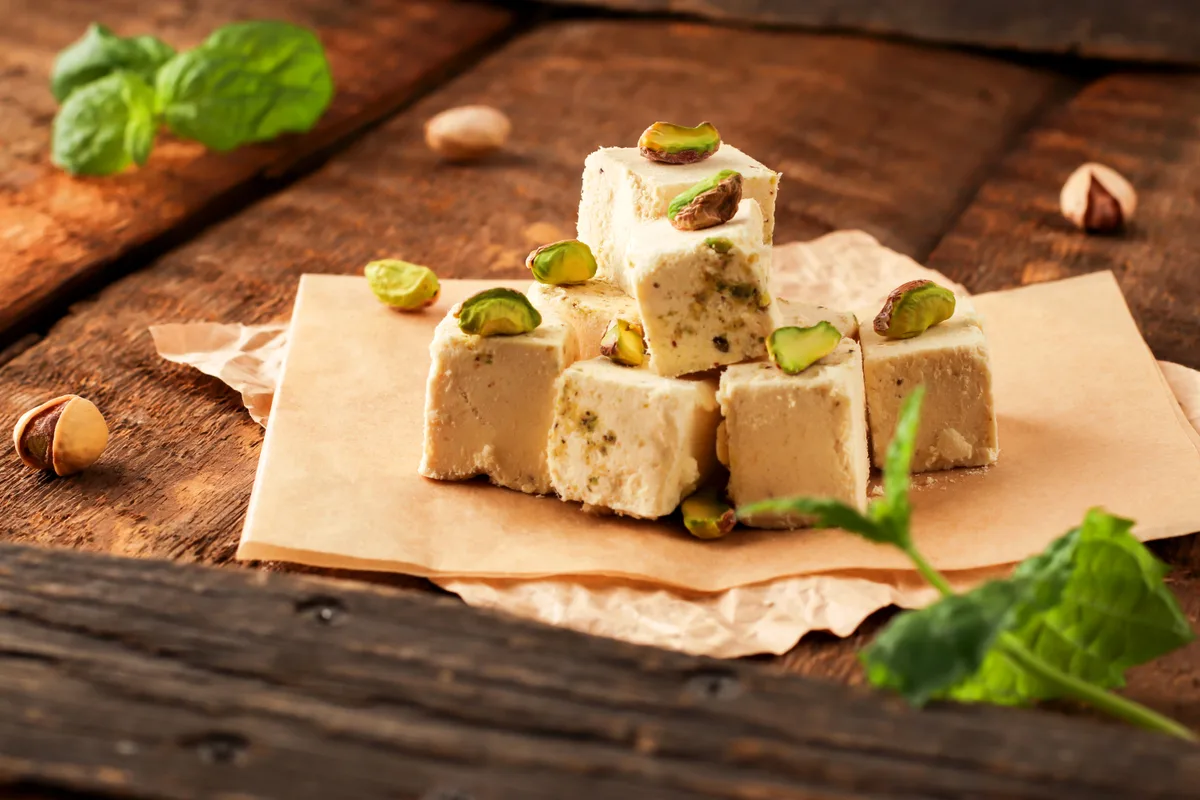
A market this established rewards depth over novelty: the spices and za'atar rack that anchors a Levantine kitchen, Aleppo soap for gift and boutique retail, and shelf-stable sweets and pantry lines that suit both a restaurant counter and a grocery shelf. Ibrahim Srour's pistachio halawa, pressed to a Damascus recipe, is a good example of the kind of producer-named authenticity this market recognizes and rewards.
Foodservice and retail pull from the same catalogue in different proportions. A Mississauga shawarma line or Levantine café leans on dedicated shawerma spice blends, bulk sumac and cardamom coffee for the counter, while a grocery shelf gives more of its space to sweets and bakery lines and the giftable end of the soap rack. Both kinds of buyer send the same kind of inquiry — the difference is case sizes and repeat frequency, which the quotation is built to reflect.
Buying works the same way here as anywhere in the catalogue: one inquiry across every category, a written quotation back within about a business day, delivery confirmed on the quotation — see how inquiry ordering works.
Related questions
Why does Mississauga get its own guide instead of being grouped with the rest of the GTA?
Its Arabic-speaking and Muslim population is large enough, and its retail and foodservice geography distinct enough, to register clearly on its own — 33,265 residents reported Arabic as a mother tongue and 120,965 as Muslim in the 2021 Census. Other GTA municipalities are covered together in one delivery-focused guide rather than needing individual pages.
What share of Mississauga's population is Muslim?
About 16.9% — 120,965 people in the 2021 Census, noticeably higher than the roughly 10.1% average across the Toronto CMA as a whole.
Is Arabic a widely spoken language in Mississauga?
Yes. The 2021 Census recorded Arabic as Mississauga's second most common non-official mother tongue, after Urdu, with 33,265 residents reporting it and 49,495 able to converse in it.
Do you deliver to Mississauga?
Yes — Mississauga is part of the standard GTA delivery area. See where we deliver across the GTA for the full list of municipalities and how delivery is confirmed on your quotation.